Press Release
Feb 21, 2026
The Youth for Better Buses Demand Charter
Our detailed campaign charter demanding urgent improvements to Delhi's public bus system
YFBB Team
Introduction
Five years ago, in January 2019, the Delhi government announced the free bus scheme for women, the first Indian state to do so. Last year, in the run-up to the state legislative assembly elections, Arvind Kejriwal, the former Chief Minister of Delhi and the national convener of the Aam Aadmi Party promised to make buses free for all students if they come back to power. These schemes and promises underline the importance of accessing cheap public transportation in improving the educational and occupational outcomes of people in a rapidly growing city like Delhi.
Despite the introduction of a free bus scheme for women, we know that persistent issues of buses not stopping for women, buses being unreliable and infrequent, women facing sexual harassment on the bus and bus stops, and overcrowding have not ceased to exist (Ollivier et al., 2022; Shah et al., 2023). Rather, such barriers are making it difficult for women to accrue the full benefits of such a scheme.
Therefore, simply providing bus subsidies will not ease spatial and economic barriers for marginalised groups in accessing education and livelihoods. The government has to significantly improve the quality of bus service in terms of safety, reliability and accessibility. Bus users in New Delhi, usually belong to households with no four or two-wheeler vehicles, have lower incomes and tend to belong to the most resource-poor households (Dasgupta & Datta, 2024; Gandhi & Tiwari, 2021). This means they are solely dependent on buses to access educational and livelihood opportunities.
Access to Education
The Delhi government has launched several initiatives over the past two decades to enhance access to and the quality of education at all stages. However, what is missing from the discourse on the right to education is the mobility aspect of it. Studies from several Indian cities have shown the inaccessibility of educational facilities by public transport modes such as buses (G. Sharma & Patil, 2022; Yenisetty & Bahadure, 2020).
Challenges faced while commuting can deter marginalised groups from accessing educational opportunities. For example, women in Delhi were found to choose lower-ranked colleges of Delhi University if it meant a safer commute to their college (Borker, 2021). Therefore, a narrow view of the right to education, without a policy focus on the accessibility of higher education institutions, hinders the city’s developmental agenda.
Investment in the improvement and upkeep of bus infrastructure remains abysmally low. In 2022-23, 25.02 lakh passengers on average used DTC buses, as compared to 15.62 lakh passengers in 2021-22. However, over this period, the bus fleet has increased slightly from 3,762 buses to 3,937. As a consequence, the number of passengers carried per bus daily has shot up from 487 to 756, leading to severe overcrowding on buses. While ridership of buses in Delhi has increased, there have been no efforts to supplement this altered travel behaviour of people with augmented bus fleets.
Out of the 3,937 buses in Delhi, only 30% are electric ones. Moreover, there are significant spatial inequalities across the city in terms of bus network coverage, wherein low-income neighbourhoods have lower bus accessibility than high-income neighbourhoods (Roychowdhury & Das, 2021). It has been found that in areas of Delhi, where bus network coverage is high, a larger proportion of people opt for using buses (T. Sharma & Jain, 2025). Therefore, expanding bus network coverage can help residents of lower-income settlements to access newer educational and livelihood opportunities too.
Our Survey
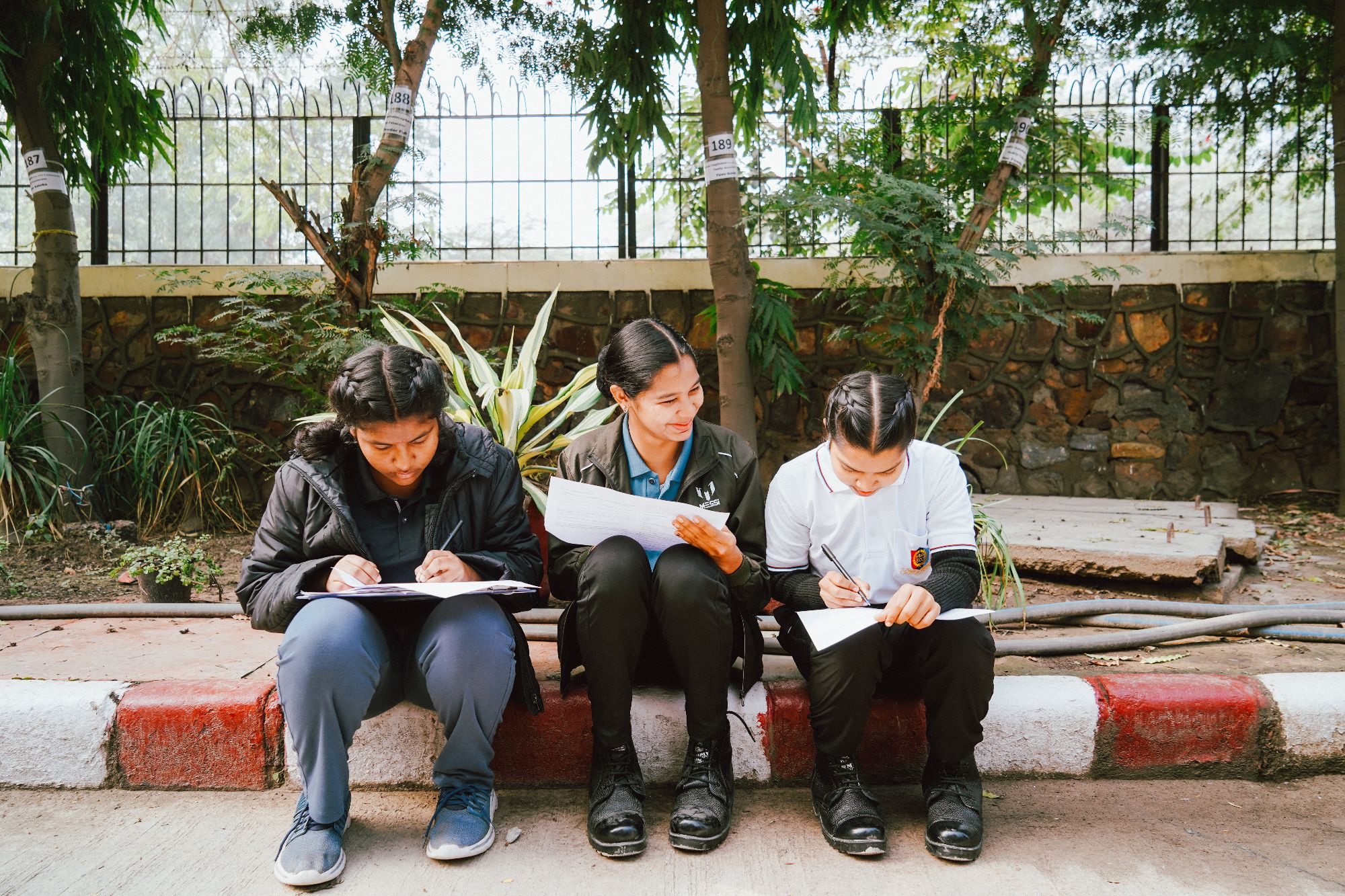
In the run-up to the Delhi elections, we conducted an on-ground survey of 812 students from 40+ colleges across Delhi. We particularly surveyed students from colleges which were more than 3 km away from the nearest metro stations, thus making the students more dependent on buses. Sites covered include Alipur, Green Park, Hamdard Nagar, Chanakyapuri, Ashok Vihar, Delhi University North Campus, Tughlaqabad, Mandi House and Narela.
Results
Our sample achieved near-equal gender representation, with 52% men and 47% women. Furthermore, more than 85% of our respondents were below the age of 21. 53% of our respondents use the bus daily, while 21% use it several times a week. 71% of the respondents said the bus was their primary mode of transportation for commuting to their college.
For a majority of the respondents (67%), the primary reason for choosing the bus was its affordability. This supports earlier findings from Delhi, which indicate that bus users are usually cost-sensitive and use the bus because of its low fares. Other major reasons for choosing the buses included accessibility (34%), convenience (24%) and lack of other options (22%). 31% of the respondents spend less than 30 minutes commuting by bus, while 36% spend anywhere between 30 minutes to an hour. However, we find that 21% of the respondents spend 1-2 hours commuting by bus, followed by 10% of people spending more than 2 hours.
Respondents were asked to indicate the severity of the challenges they face while commuting on buses on a scale of 1 (no issue) to 5 (significant issue). According to the respondents, among all the challenges listed, overcrowding in buses was the most pressing issue in buses, with an average score of 4.3. This was followed by delayed and irregular bus service (3.8). Lack of seating and accessibility for disabled people had a score of 3.5, while lack of safety for women and other marginalised communities had a score of 3.3.
When asked which issues they had faced while commuting by bus, 64% of the respondents had faced long waiting times, 57% of them had been robbed, and 43% of them had encountered poorly maintained buses. 31% of the respondents reported having safety concerns at bus stops, and 23% mentioned having faced sexual harassment during their commute.
Demands
Our survey had two questions, asking students about the improvements they would like to see in the bus service in the city. Here are the three key demands:
Expand and Upgrade Delhi’s Bus Fleet: Increase the city’s bus fleet to 15,500 standard buses and 2,500 Mohalla buses by 2025 to meet the Service Level Benchmark of 60 buses per lakh population, as mandated by the Ministry of Housing and Urban Affairs (MoHUA). Prioritise underserved, peripheral, and resettlement areas to improve spatial accessibility and last-mile connectivity. Ensure all buses are fully operational, zero-emission, and replace all overaged buses to maintain standards, functionalities, consequentiality, reliability, and efficiency.
Implement Real-Time Bus Tracking for Reliability: Enforce a real-time GPS-based live tracking system, similar to metro stations, using onboard intelligent transport systems (OBITS). This includes Automatic Vehicle Location Systems (AVLS) integrated with Public Information System (PIS) boards on buses and Variable Message Sign (VMS) boards at 500 major bus stops by the end of 2025. This system will display expected arrival times, reducing uncertainty and long wait times, and improving the commuter experience.
Ensure Safe and Inclusive Public Transport: Strengthen commuter safety through regular safety audits, gender-disaggregated data collection, and public consultations. Implement gender-responsive policies such as mandatory halting of buses for women at stops and on-demand at night, and mandatory gender sensitisation training for bus staff. Install CCTV cameras, distress buttons, and conduct awareness campaigns via audio-visual public information systems.
Increase the representation of women and trans people in the transport workforce with set targets for hiring, retention, and promotion. Upgrade 500 busiest bus stops distributed equitably across Delhi with proper shelters, lighting, clean public toilets, free drinking water, and shaded waiting areas to ensure safer and more comfortable travel, especially during extreme weather conditions like heatwaves.
Introduction
Five years ago, in January 2019, the Delhi government announced the free bus scheme for women, the first Indian state to do so. Last year, in the run-up to the state legislative assembly elections, Arvind Kejriwal, the former Chief Minister of Delhi and the national convener of the Aam Aadmi Party promised to make buses free for all students if they come back to power. These schemes and promises underline the importance of accessing cheap public transportation in improving the educational and occupational outcomes of people in a rapidly growing city like Delhi.
Despite the introduction of a free bus scheme for women, we know that persistent issues of buses not stopping for women, buses being unreliable and infrequent, women facing sexual harassment on the bus and bus stops, and overcrowding have not ceased to exist (Ollivier et al., 2022; Shah et al., 2023). Rather, such barriers are making it difficult for women to accrue the full benefits of such a scheme.
Therefore, simply providing bus subsidies will not ease spatial and economic barriers for marginalised groups in accessing education and livelihoods. The government has to significantly improve the quality of bus service in terms of safety, reliability and accessibility. Bus users in New Delhi, usually belong to households with no four or two-wheeler vehicles, have lower incomes and tend to belong to the most resource-poor households (Dasgupta & Datta, 2024; Gandhi & Tiwari, 2021). This means they are solely dependent on buses to access educational and livelihood opportunities.
Access to Education
The Delhi government has launched several initiatives over the past two decades to enhance access to and the quality of education at all stages. However, what is missing from the discourse on the right to education is the mobility aspect of it. Studies from several Indian cities have shown the inaccessibility of educational facilities by public transport modes such as buses (G. Sharma & Patil, 2022; Yenisetty & Bahadure, 2020).
Challenges faced while commuting can deter marginalised groups from accessing educational opportunities. For example, women in Delhi were found to choose lower-ranked colleges of Delhi University if it meant a safer commute to their college (Borker, 2021). Therefore, a narrow view of the right to education, without a policy focus on the accessibility of higher education institutions, hinders the city’s developmental agenda.
Investment in the improvement and upkeep of bus infrastructure remains abysmally low. In 2022-23, 25.02 lakh passengers on average used DTC buses, as compared to 15.62 lakh passengers in 2021-22. However, over this period, the bus fleet has increased slightly from 3,762 buses to 3,937. As a consequence, the number of passengers carried per bus daily has shot up from 487 to 756, leading to severe overcrowding on buses. While ridership of buses in Delhi has increased, there have been no efforts to supplement this altered travel behaviour of people with augmented bus fleets.
Out of the 3,937 buses in Delhi, only 30% are electric ones. Moreover, there are significant spatial inequalities across the city in terms of bus network coverage, wherein low-income neighbourhoods have lower bus accessibility than high-income neighbourhoods (Roychowdhury & Das, 2021). It has been found that in areas of Delhi, where bus network coverage is high, a larger proportion of people opt for using buses (T. Sharma & Jain, 2025). Therefore, expanding bus network coverage can help residents of lower-income settlements to access newer educational and livelihood opportunities too.
Our Survey
In the run-up to the Delhi elections, we conducted an on-ground survey of 812 students from 40+ colleges across Delhi. We particularly surveyed students from colleges which were more than 3 km away from the nearest metro stations, thus making the students more dependent on buses. Sites covered include Alipur, Green Park, Hamdard Nagar, Chanakyapuri, Ashok Vihar, Delhi University North Campus, Tughlaqabad, Mandi House and Narela.
Results
Our sample achieved near-equal gender representation, with 52% men and 47% women. Furthermore, more than 85% of our respondents were below the age of 21. 53% of our respondents use the bus daily, while 21% use it several times a week. 71% of the respondents said the bus was their primary mode of transportation for commuting to their college.
For a majority of the respondents (67%), the primary reason for choosing the bus was its affordability. This supports earlier findings from Delhi, which indicate that bus users are usually cost-sensitive and use the bus because of its low fares. Other major reasons for choosing the buses included accessibility (34%), convenience (24%) and lack of other options (22%). 31% of the respondents spend less than 30 minutes commuting by bus, while 36% spend anywhere between 30 minutes to an hour. However, we find that 21% of the respondents spend 1-2 hours commuting by bus, followed by 10% of people spending more than 2 hours.
Respondents were asked to indicate the severity of the challenges they face while commuting on buses on a scale of 1 (no issue) to 5 (significant issue). According to the respondents, among all the challenges listed, overcrowding in buses was the most pressing issue in buses, with an average score of 4.3. This was followed by delayed and irregular bus service (3.8). Lack of seating and accessibility for disabled people had a score of 3.5, while lack of safety for women and other marginalised communities had a score of 3.3.
When asked which issues they had faced while commuting by bus, 64% of the respondents had faced long waiting times, 57% of them had been robbed, and 43% of them had encountered poorly maintained buses. 31% of the respondents reported having safety concerns at bus stops, and 23% mentioned having faced sexual harassment during their commute.
Demands
Our survey had two questions, asking students about the improvements they would like to see in the bus service in the city. Here are the three key demands:
Expand and Upgrade Delhi’s Bus Fleet: Increase the city’s bus fleet to 15,500 standard buses and 2,500 Mohalla buses by 2025 to meet the Service Level Benchmark of 60 buses per lakh population, as mandated by the Ministry of Housing and Urban Affairs (MoHUA). Prioritise underserved, peripheral, and resettlement areas to improve spatial accessibility and last-mile connectivity. Ensure all buses are fully operational, zero-emission, and replace all overaged buses to maintain standards, functionalities, consequentiality, reliability, and efficiency.
Implement Real-Time Bus Tracking for Reliability: Enforce a real-time GPS-based live tracking system, similar to metro stations, using onboard intelligent transport systems (OBITS). This includes Automatic Vehicle Location Systems (AVLS) integrated with Public Information System (PIS) boards on buses and Variable Message Sign (VMS) boards at 500 major bus stops by the end of 2025. This system will display expected arrival times, reducing uncertainty and long wait times, and improving the commuter experience.
Ensure Safe and Inclusive Public Transport: Strengthen commuter safety through regular safety audits, gender-disaggregated data collection, and public consultations. Implement gender-responsive policies such as mandatory halting of buses for women at stops and on-demand at night, and mandatory gender sensitisation training for bus staff. Install CCTV cameras, distress buttons, and conduct awareness campaigns via audio-visual public information systems.
Increase the representation of women and trans people in the transport workforce with set targets for hiring, retention, and promotion. Upgrade 500 busiest bus stops distributed equitably across Delhi with proper shelters, lighting, clean public toilets, free drinking water, and shaded waiting areas to ensure safer and more comfortable travel, especially during extreme weather conditions like heatwaves.
References
Borker, G. (2021). Safety First: Perceived Risk of Street Harassment and Educational Choices of Women. The World Bank. https://doi.org/10.1596/1813-9450-9731
Dasgupta, A., & Datta, A. (2024). Gendered Transport Subsidy and its Short Run Effect on Female Employment: Evidence from Delhi’s Pink Pass Scheme (SSRN Scholarly Paper No. 5017613; Issue 5017613). Social Science Research Network. https://doi.org/10.2139/ssrn.5017613
Gandhi, S., & Tiwari, G. (2021). Sociopsychological, Instrumental, and Sociodemographic Determinants of Travel Mode Choice Behavior in Delhi, India. Journal of Urban Planning and Development, 147(3), 04021028. https://doi.org/10.1061/(ASCE)UP.1943-5444.0000710
Ollivier, G., Nikore, M., & Natasha, S. (2022). India—Toolkit for Enabling Gender Responsive Urban Mobility and Public Spaces. World Bank.
Roychowdhury, A., & Das, A. (2021). How Accessible are Low Income Settlements: The Case of Delhi. Centre for Science and Environment.
Shah, S., Rajiv, R. M., & Lokre, A. (2023). Moving Toward Gender-Equitable Transportation in Post-COVID-19 Urban South Asia. Transportation Research Record: Journal of the Transportation Research Board, 2677(4), Article 4. https://doi.org/10.1177/03611981221111369
Sharma, G., & Patil, G. R. (2022). Spatial and social inequities for educational services accessibility—A case study for schools in Greater Mumbai. Cities, 122, 103543. https://doi.org/10.1016/j.cities.2021.103543
Sharma, T., & Jain, S. (2025). Retrospective cross-sectional observational study on commuters’ travel behaviour and preferences in Delhi: Impact of built environment, individual attitude and socio-economic factors. Transport Policy, 161, 17–30. https://doi.org/10.1016/j.tranpol.2024.11.002
Yenisetty, P. T., & Bahadure, P. (2020). Spatial accessibility measures to educational facilities from public transit: A case of Indian cities. Smart and Sustainable Built Environment, 10(2), 258–273. https://doi.org/10.1108/SASBE-11-2019-0153
Copyright © Youth for Better Buses, 2026
Made in Delhi. Designed by Darsh Vatsa
Copyright © Youth for Better Buses, 2026
Made in Delhi. Designed by Darsh Vatsa
Copyright © Youth for Better Buses, 2026
Made in Delhi. Designed by Darsh Vatsa
Copyright © Youth for Better Buses, 2026
Made in Delhi. Designed by Darsh Vatsa